Macchina per Viaggiare nel tempo? una studente di dottorato pubblica l'articolo su come costruirla
È possibile viaggiare nel tempo? Dottoressa Caroline Mallary ha pubblicato un articolo su come costruire una macchina del tempo
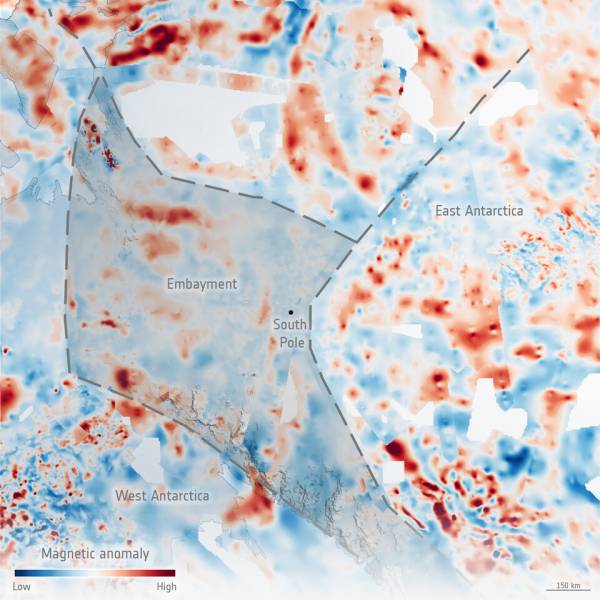
It’s very difficult to know what lies beneath a blanket of kilometres-thick ice, so it is hardly surprising that scientists have long contested the shape and geology of the ancient supercontinent from which East Antarctica formed over a billion years ago. An ESA-funded study can now lay some of this conjecture to rest. Using sensors on aircraft to measure changes in the gravity and magnetic signatures of the different rocks under the ice, scientists have discovered a huge bay the size of the UK formed part of the edge of East Antarctica.
• Otx2 binds to the promoter/enhancer region of Oct4, Sox2, and Nanog in ESCs and EpiSCs • Otx2 binding to the Nanog promoter helps maintain the integrity of ESC compartments • Loss of this Otx2-binding site induces primed-like features in ESCs • Otx2 regulation of Nanog contributes to ICM differentiation of the epiblast Mouse embryonic stem cells (ESCs) and the inner cell mass (ICM)-derived epiblast exhibit naive pluripotency. ESC-derived epiblast stem cells (EpiSCs) and the postimplantation epiblast exhibit primed pluripotency. Although core pluripotency factors are well-characterized, additional regulators, including Otx2, recently have been shown to function during the transition from naive to primed pluripotency. Here we uncover a role for Otx2 in the control of the naive pluripotent state. We analyzed Otx2-binding activity in ESCs and EpiSCs and identified Nanog, Oct4, and Sox2 as direct targets. To unravel the Otx2 transcriptional network, we targeted the strongest Otx2-binding site in the Nanog promoter, finding that this site modulates the size of specific ESC-subtype compartments in cultured cells and promotes Nanog expression in vivo, predisposing ICM differentiation to epiblast. Otx2-mediated Nanog regulation thus contributes to the integrity of the ESC state and cell lineage specification in preimplantation development.
Silencing of Keratinocyte Growth Factor Receptor Restores 5-Fluorouracil and Tamoxifen Efficacy on Responsive Cancer Cells.Sabrina Rotolo 1, Simona Ceccarelli 1, Ferdinando Romano 1, Luigi Frati 1,2, Cinzia Marchese 1, Antonio Angeloni 1* 1 Dipartimento di Medicina Sperimentale, Universita` Sapienza di Roma, Roma, Italy, 2 Istituto Neurologico Mediterraneo ‘‘Neuromed, Pozzilli, ItalyAbstract : BackgroundKeratinocyte growth factor receptor (KGFR) is a splice variant of the FGFR2 gene expressed in epithelial cells. Activation of KGFR is a key factor in the regulation of physiological processes in epithelial cells such as proliferation, differentiation and wound healing. Alterations of KGFR signaling have been linked to the pathogenesis of different epithelial tumors. It has been also hypothesized that its specific ligand, KGF, might contribute to the development of resistance to 5-fluorouracil (5-FU) in epithelial cancers and tamoxifen in estrogen-positive breast cancers.Abstract : Methodology/Principal FindingsSmall interfering RNA was transfected into a human keratinocyte cell line (HaCaT), a breast cancer derived cell line (MCF-7) and a keratinocyte primary culture (KCs) to induce selective downregulation of KGFR expression. A strong and highly specific reduction of KGFR expression was observed at both RNA (reduction = 75.7%, P = 0.009) and protein level. KGFR silenced cells showed a reduced responsiveness to KGF treatment as assessed by measuring proliferation rate (14.2% versus 39.0% of the control cells, P
Food spoilage, food infections and intoxications caused by microorganisms and methods for their detection Dr. Neeraj Dilbaghi. Reader, Department of Bio & Nano Technology. Guru Jambheshwar University of Science and Technology Hisar- 125001 and Dr (Mrs.) S. Sharma. Professor, Department of Microbiology, CCS Haryana Agricultural University, Hisar- 125001 (Revised 25-Sep-2007) IntroductionFood Spoilage and General Principles Underlying Spoilage of Food Intrinsic Parameters Extrinsic Parameters Microbial Spoilage of Foods Spoilage of fresh and ready-to-eat meat products Spoilage of milk and milk products Spoilage of fruits and vegetables Spoilage of canned foods Major Food Borne Infections/ Intoxications Caused by Bacteria General Control Measures for Prevention of Food Borne Diseases Microbial Testing of Foods Conventional MethodsRapid Detection of Emerging High Risk Pathogens in Foods
The European Commission has adopted two guidance papers setting out criteria for the in-depth assessment of large amounts of training aid and of aid to disadvantaged and disabled workers. The guidance outlines the kind of information required by the Commission for its assessment and the assessment methodology, which is based on the balancing of the positive and negative effects of the aid. The criteria are in line with the Commission's refined economic approach in state aid analysis, based on the principles set out in the State Aid Action Plan (see IP/05/680 and MEMO/05/195 ). They are part of the Commission's efforts to clarify and simplify state aid rules.
How should we be tackling the problem of poverty? What is the best way of managing our natural resources and the environment? How should we finance development? With an eye to the forthcoming major international events at which these and other questions will be discussed the Monterrey Conference on development financing (March 2002), the World Summit for sustainable development (in September 2002), and the practical application of the Doha development agenda of November 2001, the European Commission is proposing a first set of responses, making a forceful case for multilateralism as the only effective way of addressing these global challenges. The three communications which the Commission today adopted, at the initiative of President Romano Prodi, the Member of the Commission responsible for economic and monetary affairs, Pedro Solbes and the Member responsible for development and humanitarian aid, Poul Nielson, will be widely discussed within civil society and by the public at large.
MaRS is using the radio signals that convey data and instructions between the spacecraft and Earth to probe the planet's ionosphere, atmosphere, surface and even the interior. Information on the interior can be gleaned from the planet's gravity field, which will be calculated from changes in the velocity of the spacecraft relative to Earth. Surface roughness will be deduced from the way in which the radio waves are reflected from the Martian surface. Credits: ESA/C.Carreau
The aim of the future PROGRESS programme is to provide financial support for the implementation of the European Union's objectives in the field of employment and social affairs. It will thus contribute to the achievement of the Lisbon Strategy objectives. PROGRESS, the budget for which is 743 million, will finance analysis, mutual learning, awareness-raising and dissemination activities, as well as assistance for the main players over the period 2007-2013. The programme will be divided into five sections corresponding to five main fields of activity: employment, social protection and inclusion, working conditions, diversity and combating discrimination, and equality between women and men.
“TRUTH OVER FEAR: COVID-19, THE VACCINE, AND THE GREAT RESET” Dear friends and enemies of Stilum Curiae, we are happy to publish this message from Archbishop Viganò. Enjoy your reading. This Letter reflects in large measure the intervention I will be giving to attendees of the upcoming summit “Truth Over Fear: Covid-19, the Vaccine, and the Great Reset,” on April 30-May 1, 2021, organized by Patrick Coffin. This vital event features over 20 of the world’s top doctors, researchers, and attorneys, and will deliver a scientific and common sense approach to the pseudo-pandemic. All people have a right to informed consent. Registration is here: http://www.restoretheculture.com
Pat Mooney has more than four decades experience working in international civil society, first addressing aid and development issues and then focusing on food, agriculture and commodity trade. Mooney’s more recent work has focused on geoengineering, nanotechnology, synthetic biology and global governance of these technologies as well as corporate involvement in their development. The author or co-author of several books on the politics of biotechnology and biodiversity, Pat Mooney received The Right Livelihood Award (the “Alternative Nobel Prize“) in the Swedish Parliament in 1985. In 1998 Mooney received the Pearson Medal of Peace from Canada’s Governor General. He also received the American “Giraffe Award“ given to people “who stick their necks out“. Pat Mooney has no university training, but is widely regarded as an authority on agricultural biodiversity and new technology issues.