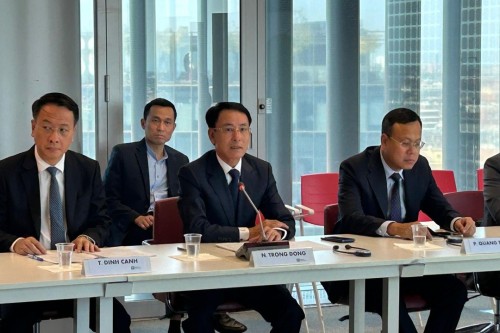
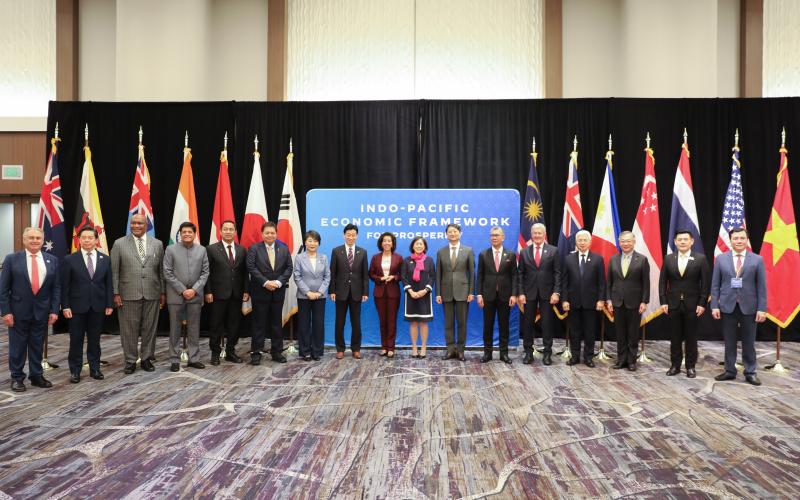
BANGKOK – Today, U.S. Secretary of Commerce Gina Raimondo joined Thai Deputy Prime Minister and Foreign Minister Parnpree Bahiddha-Nukara along with ministers from the other 12 IPEF partners in their first ministerial meeting of the year.
During the virtual ministerial meeting on Pillars II-IV, Secretary Raimondo welcomed the significant progress made since the substantive conclusion of negotiations for the proposed IPEF Clean Economy Agreement, the IPEF Fair Economy Agreement, and the IPEF Agreement in November 2023. IPEF partners also discussed the ongoing cooperative work for the three proposed agreements.
Additionally, the Secretary welcomed the entry into force, on February 24, 2024, of the IPEF Supply Chain Agreement, and reiterated the U.S. commitment to working closely with IPEF partners to promptly operationalize the agreement. Following these developments, the Department of Commerce today released the text of the proposed Clean Economy Agreement, Fair Economy Agreement, and IPEF Agreement.
IPEF partners also discussed next steps to achieve tangible outcomes within the Framework in the coming months. This includes several new efforts under the Clean Economy pillar, including the launch of four new Cooperative Work Programs (CWPs), the announcement that the first IPEF Clean Economy Investor Forum will be held in Singapore on June 5-6, and further details on the IPEF Catalytic Capital Fund.
IPEF partners also announced that Ministers will convene in person in Singapore on June 6 to discuss the Supply Chain Agreement, Clean Economy Agreement, Fair Economy Agreement, and IPEF Agreement.
"I continue to be amazed by the energy and collaborative spirit that each of our IPEF partners brings to the table and by what we've accomplished together in such a short time," said Secretary of Commerce Gina Raimondo. "This framework did not exist less than two years ago. And now, from the completion of the legal review of the proposed Clean Economy and Fair Economy Agreements and the IPEF Agreement, to the entry into force of the Supply Chain Agreement and the launch of additional significant initiatives, it's clear that the next phase of IPEF will continue to deliver concrete results for each of our economies."
Department of Commerce Publishes Texts of Key Clean Economy, Fair Economy, and IPEF Agreements
Following the substantive conclusion of negotiations of the three proposed agreements in November 2023, IPEF partners conducted an intensive legal review, including an in-person meeting held in Washington, D.C., from February 19 to 23, 2024. Having completed the legal review process, IPEF partners today took a significant step forward with the finalization of the texts of the three proposed agreements. IPEF partners will now undertake their respective internal processes to prepare for the signing of the agreements, followed by acceptance, approval, or ratification.
Progress made under the proposed Clean Economy Agreement is a significant step forward in the Administration's efforts as an international leader in climate action. In particular, the proposed agreement establishes a foundation upon which IPEF partners can work together to pursue net-zero emissions economies and promote sustainable growth and success across all partner economies. The proposed agreement reflects the shared goal of partners to work together and with the private sector to improve the business environment so that U.S. companies, as well as those of IPEF partners, have more export and investment opportunities, thus supporting strong jobs at home. At the same time, the proposed agreement emphasizes the importance of supporting U.S. workers and communities and IPEF partners during the transition process.
The proposed Fair Economy Agreement aims to create a fairer playing field for U.S. workers and businesses, as well as those of IPEF partners, and to create a more transparent and predictable business and investment environment in the Indo-Pacific. To achieve these goals, under the proposed agreement, IPEF partners would work together to enhance their efforts to prevent and combat corruption, including corruption and support efforts to improve tax transparency and information sharing, mobilize domestic resources, and tax administration.
To ensure effective implementation of initiatives across the pillars and agreements of IPEF, as well as to ensure the Framework's long-term sustainability for continued economic cooperation, the Proposed IPEF Agreement establishes two ministerial-level bodies, each to meet annually: an IPEF Council, which will examine issues affecting the collective operation of IPEF agreements and the Framework as a whole, including proposals for negotiations on new agreements and the accession of new members; and a Joint Commission to monitor work under the Supply Chain Agreement, Clean Economy Agreement, and Fair Economy Agreement, in order to identify cross-cutting synergies and avoid duplication of work.
As part of its ongoing commitment to transparency, the Department of Commerce is making public the texts of the three proposed agreements, which can be viewed here on its website.
Pillar II: Building Supply Chain Resilience for the Indo-Pacific
Following the signing of the IPEF Supply Chain Agreement in November 2023, the agreement entered into force on February 24, 2024, after five partners deposited their instruments of ratification, acceptance, or approval. IPEF partners are now working to operationalize the agreement, including appointing their representatives to the three bodies of the agreement (the Supply Chain Council, Crisis Response Network, and Labor Rights Advisory Council), establishing chairs, and adopting terms of reference for each, as well as identifying their respective initial lists of critical sectors and key goods for cooperation under the agreement.
Pillar III: Cooperating to Accelerate Transition to Cleaner IPEF Economies
IPEF partners also discussed progress made under Pillar III since the substantive conclusion of negotiations for the proposed Clean Economy Agreement in November 2023.
IPEF partners welcomed the First IPEF Clean Economy Investor Forum, to be held in Singapore on June 5-6, 2024. The Forum will bring together some of the region's largest investors and philanthropists with government agencies and innovative companies and entrepreneurs to mobilize increased investment for climate-related infrastructure, technologies, and projects in the region. These investments will advance the goals of the 14 IPEF partner countries outlined in the proposed Clean Economy Agreement. For more information and future updates, please visit: www.IPEFinvestorforum.org.
IPEF partners also announced plans to provide $33 million in initial funding for the IPEF Catalytic Capital Fund under Pillar III of the Clean Economy Agreement. These funds will be critical to catalyzing up to $3.3 billion in private investments for climate infrastructure projects in IPEF countries party to the IPEF Clean Economy Agreement. Founding supporters of the Fund include Australia, Japan, Republic of Korea, and the United States, which will take steps to complete their respective internal processes to contribute to the funds, as well as raise awareness about the Fund and its opportunities for public and private sector stakeholders. The Private Infrastructure Development Group will administer and leverage the Fund to deploy concessionary financing, technical assistance, and capacity support to develop a pipeline of high-quality, resilient, and inclusive climate infrastructure projects.
Additionally, IPEF partners took stock of the hydrogen CWP announced in May 2023, as well as potential new CWPs. Under the proposed agreement, CWPs are a mechanism through which IPEF partners or a group of partners prioritize their focus and resources on a common objective. On hydrogen, interested IPEF partners have taken steps to advance the initiative, including establishing workstreams related to information exchange and sharing of best practices on methodologies, standards, and certifications developed by international organizations on hydrogen and its carriers' carbon intensity, as well as cross-border pilot and demonstrative projects.
IPEF partners also announced four new CWPs based on proposals advanced by partners:
On carbon markets, interested IPEF partners initially seek to understand existing regional carbon market priorities and identify strategies to improve enabling conditions for cooperation;
Interested IPEF partners are also pursuing clean electricity enhancement to facilitate further decarbonization and access to clean energy in the region, including through public-private cooperation;
To promote job creation and labor rights and strengthen efforts to address employment changes in transitioning to clean energy, interested IPEF partners commit to pursuing workforce development efforts to ensure a just transition towards achieving a clean economy; and
Interested IPEF partners will collaborate on Sustainable Aviation Fuels (SAF) to improve the availability and accessibility of SAF and its feedstocks, in order to catalyze and develop regional SAF value chains in the region.
Pillar IV: Enhancing Transparency and Predictability in the Business Environment
IPEF partners also discussed ways to achieve timely outcomes under the proposed Pillar IV of the Fair Economy Agreement to promote a more predictable and transparent business environment and contribute to increased business and investment activity among partners. Recognizing the critical role of Technical Assistance and Capacity Building (TACB) in meeting the commitments outlined in the proposed agreement and ensuring effective implementation and application of anticorruption measures and tax administration improvement, partners commit to continue identifying and implementing TACB initiatives to strengthen anticorruption efforts and tax administration efficiency
About IPEF
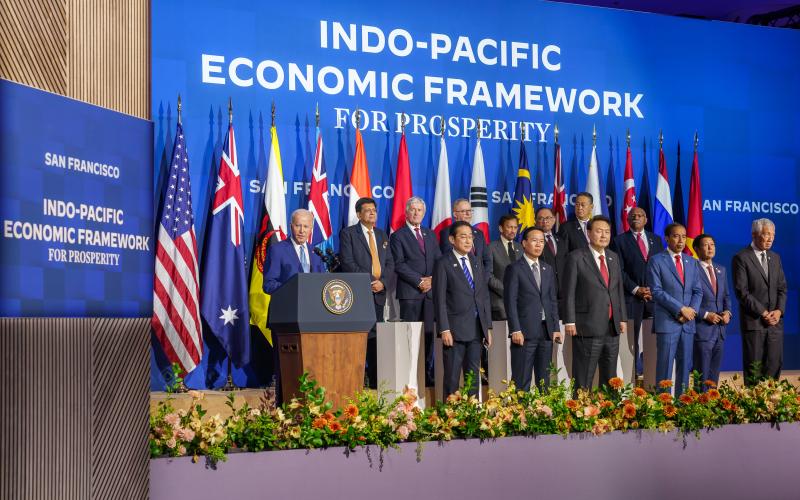
In May 2022, President Biden launched the IPEF, bringing together 14 regional partners - Australia, Brunei, Fiji, India, Indonesia, Japan, Republic of Korea, Malaysia, New Zealand, Philippines, Singapore, Thailand, United States, and Vietnam - in a new model of economic cooperation. IPEF negotiations commenced in late 2022. In May 2023, IPEF partners announced the substantive conclusion of negotiations for a first comprehensive IPEF Supply Chain Agreement. In November 2023, IPEF partners announced the substantive conclusion of negotiations for the proposed Clean Economy and Fair Economy Agreements, as well as a proposed global IPEF Agreement to ensure the Framework's sustainability and held a signing ceremony for the IPEF Supply Chain Agreement.
Useful Links:
- IPEF Ministerial Joint Statement November 2023 https://www.commerce.gov/news/press-releases/2023/...
- Proposed IPEF Clean Economy Agreement (full text) https://www.commerce.gov/sites/default/files/2024-...
- Proposed IPEF Fair Economy Agreement (full text) https://www.commerce.gov/sites/default/files/2024-...
- Proposed IPEF Agreement (full text) https://www.commerce.gov/sites/default/files/2024-...
#IPEF #CleanEconomy #EconomicCooperation #BusinessEnvironment #Investments
This IPEF ministerial meeting represents a significant step forward towards greater economic cooperation in the Indo-Pacific. With progress made in key pillars such as clean economy and business transparency, IPEF partners are working together to address regional challenges and promote sustainable growth. However, the task remains to ensure effective implementation of proposed agreements and engagement of all members to maximize benefits for all involved economies. Continued collaboration and concrete implementation of initiatives like the IPEF Catalytic Capital Fund will be crucial in addressing climate challenges and promoting a prosperous future in the Indo-Pacific.
Glossary
- IPEF: Indo-Pacific Economic Framework
- CWP: Cooperative Work Program
- SAF: Sustainable Aviation Fuels
- TACB: Technical Assistance and Capacity Building